
How Courts Handle Violent Crime Cases and Victim Testimony
Feb. 4, 2026
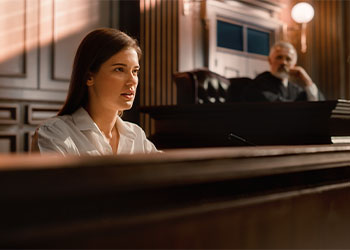 When accused of a violent crime, attention often centers on the most visible aspect of the case: the victim’s account of events. While victim testimony can carry significant weight, it is not treated as unquestionable proof. Judges and juries evaluate how the testimony aligns with the broader evidence, including physical and digital records, medical documentation, witness statements, and law enforcement reports.
That process matters for victims, defendants, and families who want to know what to expect once a case enters the court system. In Vancouver, Washington, Dan Mellen, Attorney At Law, we represent clients in criminal matters where testimony, credibility, and constitutional rights shape what the court hears and how a case proceeds.
Violent crime cases typically begin with a report, an investigation, and a charging decision. Once charges are filed, the case proceeds to early court appearances, where bail, release conditions, and no-contact orders may be addressed. From there, both sides exchange information through discovery, and the court sets deadlines for motions and trial preparation.
As the case develops, prosecutors decide what evidence they’ll present and what charges they’ll pursue. The defense evaluates the evidence, challenges questionable proof, and prepares to test the prosecution’s case at the hearing and trial.
Where Victim Testimony Fits Into the Evidence
Victim testimony is one part of the evidence, and courts look at both what is said and how it is supported. This testimony also serves different purposes depending on the phase of the case. At trial, it may be central to the jury's decision, especially when the case turns on identity, intent, or consent. Victim testimony commonly addresses these case-building topics:
How the incident began: This may involve examining the context, the relationship between the parties, and the circumstances leading up to the alleged incident.
What was perceived in the moment: This may include what the victim observed, heard, or experienced during the incident, including any threats or commands.
Physical effects and injuries: This may include pain, visible injuries, limitations, when medical care was sought, and how symptoms changed over time.
Actions taken immediately afterward: This can include calls for help, messages sent, who was told, and why certain steps were taken right away.
Identification of the accused: This may include how the victim recognized the person, what was clearly observed, and any conditions that affected visibility or certainty.
Once testimony becomes part of the case record, the next focus is on how courts allow that testimony to be examined and challenged.
Common Ways Testimony is Tested in Court
Courts generally allow both sides to cross-examine witnesses under rules designed to keep the process fair. The prosecution typically uses direct examination to present the witness’s account. The defense uses cross-examination to probe weaknesses and inconsistencies, and judges can limit questioning that is irrelevant, abusive, or prohibited by evidence rules.
Testing testimony is a structured method for evaluating reliability and accuracy, especially when memories are affected by stress, fear, injury, alcohol, or poor lighting. In practice, testimony is usually tested through specific credibility and reliability tools, including:
Consistency across accounts: Differences between what was said to the police, medical providers, friends, or in court may be examined to determine whether the story changed and why.
Opportunity to perceive and recall: The court may hear about lighting, distance, intoxication, sleep deprivation, or trauma responses that could affect perception and memory.
Bias or motive concerns: Previous conflicts, custody battles, financial stress, or relationship problems may be introduced if deemed relevant and allowed under the rules.
Corroborating and contradicting evidence: Video, photographs, text messages, injuries, and physical evidence may be used to support or challenge key parts of the account.
Prior conduct that affects credibility: In limited circumstances, the court may permit questions or evidence regarding truthfulness, subject to strict limits and judicial control.
A major source of disputed evidence in violent crime cases involves statements made outside the courtroom, raising questions about how prior statements should be treated.
Statements Made Outside Court and When They Can Be Used
Victims often speak to someone soon after an incident, such as a dispatcher, officer, nurse, family member, or friend. Those statements may or may not be admitted at trial, depending on how the rules treat hearsay and what exceptions apply. Courts often focus on when the statement was made, why it was made, and whether it was recorded or documented reliably.
When a victim testifies, prior statements may be used to establish credibility, refresh memory, or demonstrate inconsistencies. When a victim doesn’t testify, admission rules are usually stricter because the accused has constitutional rights related to confronting witnesses. Statements commonly discussed in these cases include the following:
Emergency calls and dispatch recordings: These may be used to show what was reported in real time and how the caller sounded, especially when the purpose was seeking help.
On-scene statements to responding officers: Depending on the timing and specific context, these may be assessed differently than subsequent, more detailed interviews.
Medical history given during treatment: Statements made for medical diagnosis or care may be treated differently because their purpose is tied to treatment decisions.
Written messages and digital communications: Texts, emails, and social media posts can document timing, emotions, threats, and contradictions when properly authenticated.
Formal interviews and recorded statements: Video or audio interviews can be used to evaluate detail and consistency, as well as to highlight omissions or changes.
Because these statements can carry significant weight, courts also consider privacy issues and limits on what can be asked, especially in sensitive cases.
Privacy Protections and Limits on Questioning
Courts try to balance two interests: a defendant’s right to present a defense and a witness’s right to dignity and fairness. Evidence rules can restrict irrelevant character attacks, speculation, and questioning that have little to do with the charged conduct. Judges have discretion to manage how testimony is presented, including limiting repetitive or harassing questioning.
In certain violent crime cases, additional protections can apply, such as limits on introducing sexual history or using intimidation tactics in court. Those protections don’t block legitimate defense arguments, but they can narrow the scope of what the jury hears and how topics are framed. Those boundaries become especially important when a victim is hesitant to participate, a situation courts address through specific procedures.
Consult an Experienced Lawyer Today
If you have questions about a violent crime charge and how testimony may be used in court, our attorney can explain the applicable rules and which evidence may be most relevant in your case. At Dan Mellen, Attorney at Law, we’re proud to serve Vancouver, Washington, as well as Clark County, Cowlitz County, Lewis County, and Wahkiakum County. Call today to schedule a consultation and discuss next steps.